Last updated October 20, 2026. Rules below are for unincorporated county land, taken from each county's posted regulations and permit forms on the date above, with the county office to call. Inside city limits the city's code applies instead — every county we checked says so. Confirm with the office listed before you design to a number here.
KC Horse Barn Builders builds horse barns for Kansas City acreage. Send your parcel and scope so we can confirm project availability. The county notes below cover Johnson, Miami, Leavenworth, Douglas and Franklin counties in Kansas, and Jackson, Cass, Clay, Platte, Lafayette, Ray and Clinton counties in Missouri. County research is not a guarantee of crew availability for every parcel.
One page rather than a page per town, on purpose: the thing that changes from one property to the next is the county (and whether you are inside a city), not the suburb name. The two tables below are the part of this page worth bookmarking.
The short version for both states
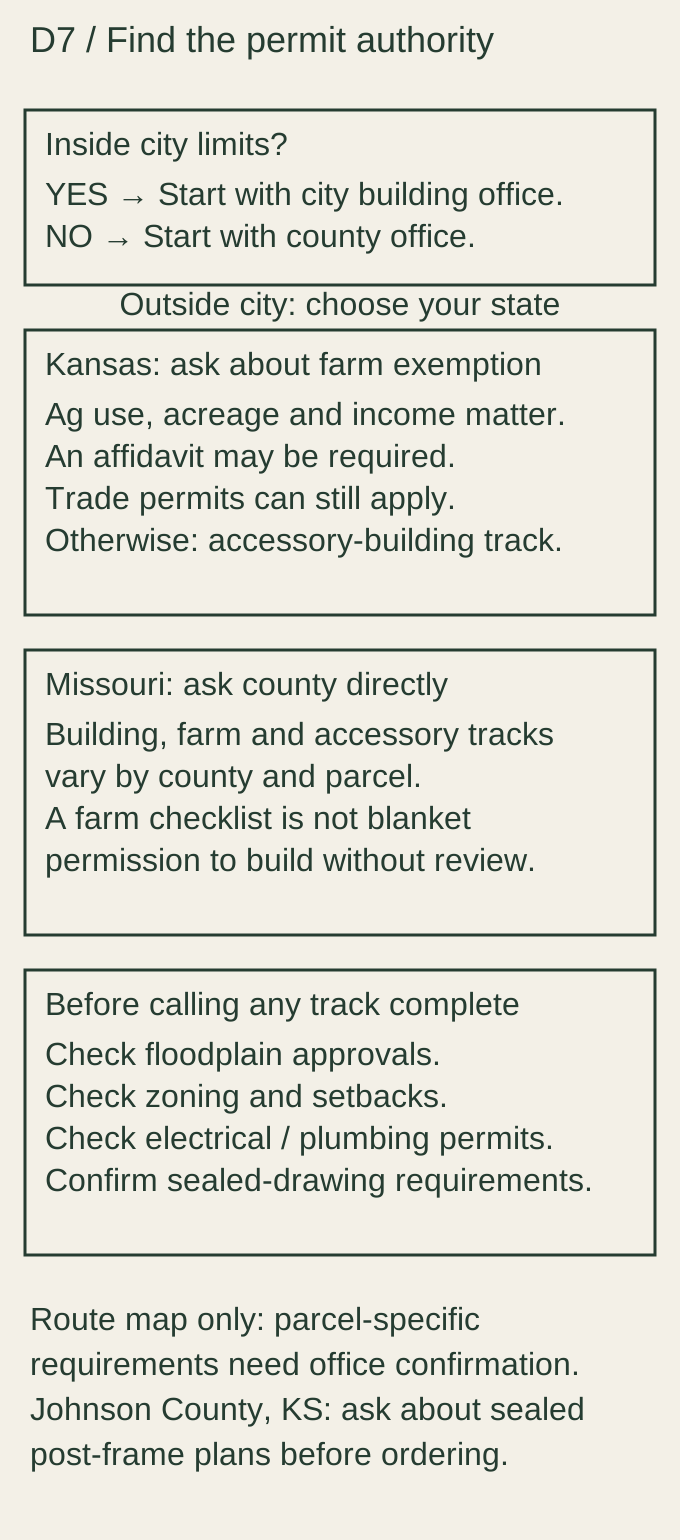
Kansas: state law (K.S.A. 19-2921 and 12-758) exempts land and buildings used for agricultural purposes from county zoning, and the Attorney General has said a county can require a prior determination that a building is exempt but cannot then plan-review or permit it. Every Kansas county we verified (Johnson, Miami, Douglas, Franklin, and Leavenworth by its posted form) asks for a notarized agricultural-use affidavit first, several tie it to acreage or farm income, and the verified counties still require electrical, plumbing and HVAC permits inside the "exempt" barn. Whether a hobby horse barn on a small residential tract counts as "agricultural" is decided by actual use, county by county — horses kept for pasturage and husbandry generally do; a Kansas court held racehorse training was not agricultural (Navarro), which the Attorney General's 2016 opinion cites.
Missouri: no statewide building code. The county zoning statutes exempt "farm structures" outside the floodplain, but a zoning exemption is not a permit exemption, and Jackson, Clay, Platte, Cass, Lafayette and Clinton counties all run a barn permit of some kind — from Jackson's flat $125–$300 "agricultural-use pole barn" fee to Clinton's five cents a square foot. Johnson County, Missouri (Warrensburg side) has no county zoning, codes or permits at all. Horse-per-acre rules and stable setbacks are written into most Missouri county codes for lots under 20 acres.
Everywhere: the floodplain is never exempt, recorded subdivision covenants can override all of it, and call 811 (Missouri One Call / Kansas 811) a few business days before the first post hole — confirm the legal notice period with 811.
Kansas-side counties
| County (unincorporated) | Permit for a private horse barn? | Agricultural exemption | Horses per acre / stable setbacks | Who to call |
|---|---|---|---|---|
| Johnson (Stilwell, Bucyrus, rural Spring Hill, De Soto) | Yes. Barns "used solely for an agricultural use" take a reduced Agriculture permit track (application, scaled site plan from a boundary survey, Land Disturbance Certification, notarized use form). Other accessory buildings ≥200 sq ft take the full permit. Post-frame and steel-frame buildings must be designed and sealed by a Kansas-registered design professional. Electrical, plumbing and mechanical: separate permits by county-licensed contractors. | Treated as a reduced-review permit with a prior determination. Whether a 2–3 horse barn on a 3-acre lot is "agricultural" is not spelled out — the horse-keeping rule to the right governs it as a residential accessory use. | On tracts under 10 acres and in all residential districts: 1 horse or pony on at least 2 acres, plus 1 more for each additional 1.5 acres; at least 1 acre of open lot area per horse. Barns and stables not in the front yard and at least 25 ft from side and rear lines. Accessory floor area capped at 1,680 sq ft on the first acre plus 560 sq ft for each additional acre under 10 acres; no cap at 10+ acres (RUR). RUR setbacks 50 front / 25 side / 25 rear; ag buildings have no height limit. Design values: 115 mph wind (exposure C), 20 psf snow. | Planning, Housing & Community Development / Building Codes, 111 S. Cherry St., Olathe — (opt. 1). Entrance permit $75 (Public Works ). Land disturbance ≥1 acre $250. Septic . |
| Miami (Louisburg, Paola, rural Spring Hill, Bucyrus south) | "A permit is required for all new structures regardless of the property's zoning," unless the ag certification applies. Electrical, plumbing and HVAC permits still required. | Notarized Certification of Agricultural Use exempts the building from zoning and building inspections except trades — but is not available on parcels under 20 acres whose primary function is residential or recreational. | County does not regulate the number of horses. AG and Countryside districts: 50 ft front / 20 side / 20 rear; new ag buildings still keep setbacks on arterials and highways. On-site wastewater permit before any building permit. | Planning & Zoning ; Code Services ; Road & Bridge (entrances) — 201 S. Pearl St., Paola. |
| Leavenworth (Tonganoxie, Basehor, rural Lansing) | Permits for most structures; under 200 sq ft unregulated. | Agricultural Exemption Application asks for livestock numbers, crops, Schedule F and an affirmation that the tract's primary use is "agricultural production as a principal business enterprise" — a hobby barn on a small tract is unlikely to qualify. | District setbacks and horse limits are in the county's 2026 regulations (not reproduced here; confirm). | Planning & Zoning, 300 Walnut St., Leavenworth — PZ@LeavenworthCounty.gov; online portal. |
| Douglas (Eudora, Baldwin City, rural Lawrence) | All accessory buildings need a permit except ≤200 sq ft sheds, unless exempted. Electrical, plumbing and HVAC permits and Health Department plumbing approval still required in exempt buildings. | Director's agricultural exemption letter, no fee: 40+ contiguous acres on the owner's certification; under 40 acres needs documentation (Schedule F or a business plan), at least 3 acres in agricultural use, and an income-producing operation. Setbacks from public roads still apply (K.S.A. 19-2960). | District horse limits not stated in the zoning text we reviewed; commercial riding stables are a conditional use. | Zoning & Codes, 3755 E. 25th St., Lawrence — ; zoning@dgcoks.gov. |
| Franklin (Wellsville, rural Ottawa) | Yes, through the online Permit Center; licensed electrical, plumbing and HVAC contractors. | Notarized Affidavit of Agricultural Use (deed + site plan); no acreage threshold on the form; a later change of use triggers inspection to current codes. The county FAQ still lists 2003 I-codes — confirm the current edition. | Residences need ≥3 acres (5 with a lagoon); setback schedule by district (confirm). | Planning & Building ; franklincoks.org/permitcenter. |
| Linn (La Cygne, rural Mound City) | Yes; Zoning Administrator, 3-business-day processing, sanitation permit required. | Not stated on the permit procedure — ask. | Agriculture: 60 ft from road centerline / 10 side / 30 rear; Ag-Residential 60 / 15 / 25. | , 315 Main St., Mound City. |
Missouri-side counties
| County (unincorporated) | Permit for a private horse barn? | Agricultural exemption | Horses per acre / stable setbacks | Who to call |
|---|---|---|---|---|
| Jackson (Lone Jack, Grain Valley–Oak Grove acreage, Buckner, Levasy) | Yes. "Agricultural-use pole barns" pay a flat fee — $125 if valued ≤$20,000, $300 for $20,000–$40,000 — and skip the plan-review surcharge. Only ≤200 sq ft sheds are exempt. 2018 I-codes and 2017 NEC per the 2025 permit packet (the posted Chapter 54 still cites 2009 — confirm). Trade work by county-licensed contractors. | None from the permit; the flat fee is the accommodation. | AG (10-acre min): animal enclosure areas (pens, corrals) ≥50 ft from any property line; pastures excepted. RR Residential Ranchette (5-acre min): 1 head of livestock per acre of pasture; barns and private stables accessory; same 50-ft enclosure rule. RE (2-acre min): private stable and up to two horses. AG setbacks 50/30/50; RR 40/20/40; ag structures up to 55 ft tall if set back their own height. | Public Works Development Division, 303 W. Walnut, Independence — . Driveway permit $107. |
| Clay (Kearney, Holt, rural Smithville, Excelsior Springs) | Reduced "Farm Building" track: farm buildings allowed only on ≥5 acres, no plumbing, bathrooms or human occupancy, Farm Building Checklist at Planning & Zoning, Public Health site approval, possibly a driveway permit. Otherwise full permit for any building over 120 sq ft. 2012 I-codes / 2011 NEC now; 2018 codes slated for January 2027. | "Farm purposes" expressly includes "pasturing, training or boarding of equines." | Large animals need ≥3 contiguous acres with ≥1 acre of continuous pasture (barns don't count); 1 horse per acre on 3–20 acres; no limit on AG 20+ acres. Buildings housing animals ≥100 ft from the front line and ≥50 ft from side and rear lines; manure piles ≥100 ft from any lot line, well or stream. Farm structures: no height limit. | Planning & Zoning, 1 Courthouse Sq., Liberty — ; pandz@claycountymo.gov. |
| Platte (Platte City, Weston, Camden Point, rural Parkville) | Yes — "accessory structures (barns, garages, sheds)" is a listed permit type; no agricultural exemption on the county's page or in the zoning order. 2018 I-codes, 2017 NEC. | None stated. Land-disturbance permits (≥1 acre) do exempt agricultural uses. | AG, RE and R-80: horses by right. Other districts: farm animals only by Special Use Permit, minimum 5 acres with ≥2 acres of continuous pasture, HOA/covenant proof required. AG: front 100 ft, accessory side 100 ft as printed (confirm), rear 50; RE: accessory side 15, rear 50. | Planning & Zoning, 415 Third St., Rm 016, Platte City — . |
| Cass (Pleasant Hill, Harrisonville, Peculiar, rural Raymore, Garden City) | Yes — Residential Accessory Building permit: $25 application + $0.25 per sq ft + electrical $0.12–$0.15 per sq ft (about $650–$700 for a 36 × 48 with power). Applications in person only. 2006 I-codes plus the county's own Post-Frame Building Standards; accessory buildings limited to 3,000 sq ft and a 14-ft sidewall (16 ft with engineering) under the prescriptive path. ≤400 sq ft sheds skip the building permit but not the zoning permit. | "Agricultural building" is defined only on 40+ contiguous acres, and the posted code shows no permit relief even then — ask. | A district: 20-acre min, 50 front / 25 side / 50 rear, farm structures no height limit. R-R: 3-acre min, 50 front, side 10% of lot width (10–25 ft), rear 30% of depth (max 50). Horse counts per lot are in Appendix A — confirm by phone. Any plumbing beyond a floor drain needs a sewage permit or exemption. | Building Codes, Environmental Health & Zoning — (6:30 a.m.–3 p.m.). |
| Lafayette (Odessa, Wellington, Lexington, Higginsville) | Yes — $300 residential accessory permit for any "development" regardless of parcel size; penalty $1,250 for building first. Code edition not posted. | No farm-building permit exemption found in the Land Development Code; a farm is presumed ≥20 contiguous acres. | Non-farm lots: corrals, stalls and barns ≥50 ft from any dwelling and ≥100 ft from any well or watercourse; ≤1 animal unit per acre after excluding 2 residential acres, and the code lists one animal unit as "0.5 horses" as printed — which reads as one horse = 2 AU (a 6-acre lot with 2 residential acres excluded = 2 horses). Confirm the Administrator's reading before counting on more. AG/RA/RE setbacks 50 front / 50 rear / 25 side. | Planning & Economic Development, 1001 Main St., Lexington — ; planning@lafayettecountymo.gov. |
| Clinton (Plattsburg, Lathrop, Gower) | Yes — "Accessory Building / Agricultural / Barn / Shed" permit at $0.05 per sq ft ($50 minimum), doubled if you start first. Any water to the building triggers a septic application. | None for permits; agricultural buildings are exempt from height limits. | A and B ag districts and R-1 ≥5 acres: 50 front / 50 rear / 15 side; R-1 under 5 acres: 30/30/10. R-1 livestock: 3–5 acres = 1 horse, scaling to 4 animal units at 13–20 acres; R-2: 1 horse per 3 acres. | Planning & Zoning, 207 N. Main St., Rm 3, Plattsburg — ; cczoning@clintoncomo.gov. |
| Johnson, MO (Warrensburg, Holden, Kingsville) | No county zoning, building code, permits or inspections (except the Whiteman AFB zoning area). Driveway permit for county-road access; floodplain permit via the Assessor; on-site wastewater via Environmental Public Health. | Not needed. | None at the county level; covenants only. | County Commission ; Environmental Health . |
Two counties are left off the tables on purpose: Ray County, Missouri has a permit program and a building inspector (; Planning & Zoning ) but its posted use tables are scanned images, so its setbacks and horse rules could not be read — call before planning; and Wyandotte County, Kansas is almost entirely inside city limits under the Unified Government's code.
Five things the tables do not say loudly enough
- "Exempt" never means no permits. On the Kansas side the structure may be exempt and the wiring, plumbing and HVAC are not; Johnson County, Kansas requires county-licensed trade contractors for all three. Budget the trade permits and the engineer's seal whatever the county says about the barn itself.
- The acreage threshold is the real gate in Kansas. Miami County's exemption is off the table under 20 acres if the property is primarily residential; Douglas wants income evidence under 40 acres; Leavenworth's form speaks of a "principal business enterprise." On a 3–10 acre horse property, plan on a permitted accessory building, not an exempt farm building.
- Missouri writes the horse math into the code. Jackson's RR district (1 head per pasture acre), Clay (1 per acre on 3–20 acres, with the 100 ft / 50 ft building setbacks and 100-ft manure rule), Clinton (1 horse on 3–5 acres) and Lafayette (as printed, one horse counts as two animal units on the acreage left after two residential acres) all cap what a small lot can carry. Check the count before you plan six stalls on five acres.
- Wash stalls and bathrooms change the permit. Clay County's farm-building track forbids plumbing fixtures outright; Clinton and Cass require a septic application for any water or fixtures; Douglas needs Health Department plumbing approval even in exempt buildings. A frost-free hydrant with no drain is the simplest case everywhere.
- Many addresses that look rural are inside a city's limits. Look the address up on the county GIS (Johnson County's AIMS, Jackson County's parcel viewer) — if a city name comes back, the city's planning desk is your first call, and the county's agricultural exemption does not travel with you.
Design values a builder should quote for this region
Johnson County, Kansas and Kansas City, Missouri both design to a 115 mph ultimate wind speed (3-second gust, Risk Category II) under their adopted 2018/2021 codes, with ground snow loads of 20–25 psf and a 36-inch frost depth. Cass County's post-frame standard is written in the older 90 mph "basic wind speed" convention of the 2006 code; under current ASCE 7 that is expressed as about 115 mph "ultimate" — roughly the same load in a different unit. Ask any bidder which wind and snow values and which convention their truss and post engineering uses; it is a one-line answer, and a vague one is a warning. The planning guide covers what those numbers mean for post-frame versus steel.
Utilities and access, briefly
- Locates: Missouri 811 / 1-800-DIG-RITE; Kansas 811 / 1-800-DIG-SAFE. Free, required; call a few business days ahead and confirm the notice period with 811.
- Road entrances: Johnson County KS $75 entrance permit with culvert inspection; Jackson County MO $107 driveway permit; Miami County KS Road & Bridge permit; Douglas County KS requires road-access approval before the exemption letter; state highways go through KDOT or MoDOT.
- Electric: territory depends on the parcel — Evergy in the metro core and a rural electric cooperative on most of the ring; the county GIS or the co-op's own service map tells you which. A new line extension to a remote pad can be a five-figure item; get the utility's quote early.
- Water: rural water districts serve most of the ring; tap fees vary (one south-metro district publishes $4,000 for a residential tap as of January 2026) and some require a separate meter for a barn. Wells: KDHE-licensed drillers in Kansas, Missouri DNR rules in Missouri.
- Manure and water: keep storage at least 100 ft from wells, ponds and streams — Clay County writes that into code; extension guidance says the same everywhere else.
Ready to find out what your parcel allows?
Send us the address, acreage and county, and we will tell you which track you are on — exempt, reduced or full permit — and what that does to the schedule, before we quote a barn. Request a project proposal, or read the cost guide first if you want to know what the permit line looks like next to the rest of the budget.
Sources, all accessed October 20, 2026: K.S.A. 19-2921 and 12-758; Kansas AG Opinion 2016-10; RSMo 64.090, 64.255, 64.620, 64.890; Johnson County KS Zoning Regulations Articles 2, 9 and 18 and the Accessory and Agriculture Building permit page; Miami County KS Zoning Regulations §6-1.01 and Certification of Agricultural Use; Leavenworth County Agricultural Exemption Application; Douglas County Zoning Regulations 12-301-2 and agricultural-exemption packet; Franklin County Affidavit of Agricultural Use; Linn County building permit procedure; Jackson County MO Chapter 54 and 2023 UDC and 2025 permit packet; Clay County Land Development Code (Sept. 2025); Platte County Zoning Order; Cass County Chapter 400/500 and Residential Accessory Building Application (Sept. 2025); Lafayette County Land Development Code (2016); Clinton County Zoning Order (July 2026) and accessory permit application; Johnson County MO Commission letter (Feb. 2026); KCMO Information Bulletin 169.